
IoT tools to collect environmental data
WP2 has developed and tested a set of technological tools to support the collection of environmental data in urban areas. The core development is the SUTEE IoT prototype, which integrates environmental sensors, wireless communication, a mobile application and an online dashboard. In addition to this IoT system, UNED and the SUTEE partners have also experimented with a broader set of electronic devices, commercial sensors and programmable educational kits that can be used to collect environmental data in different learning scenarios.
These complementary tools do not necessarily include connectivity with the SUTEE platform. Some of them are commercial measuring devices that provide visual readings on a display, while others are DiY or educational kits based on programmable boards such as Micro:bit, M5Stack or Lego Spike Prime. They have been included in the SUTEE toolbox so that teachers can choose the most appropriate technology according to their learning objectives, the age of the students, the complexity of the activity, the available time and the type of environmental variable they want to explore. This approach makes the toolbox flexible and adaptable to different educational contexts, from simple observation-based activities to more advanced STEM projects involving the design, assembly and programming of devices.
SUTEE IoT prototype
The SUTEE IoT prototype is the main IoT-based technological development of WP2. It was designed as a portable environmental monitoring system that can be used by teachers and students during outdoor learning activities in urban environments. Its main purpose is to allow learners to collect real environmental data in different city locations and use these measurements to analyse the role of trees, parks and green areas in improving urban environmental conditions.
The prototype consists of three integrated modules. The first one is an electronic prototype based on an Arduino Nano board connected to several environmental sensors. These sensors collect data on temperature, humidity, CO2 and air pollutants, including CH2O, TVOC, PM2.5 and PM10. The electronic board is integrated into a white 3D-printed case specifically created for the project and branded with the SUTEE logo. The system is powered by an external power bank, which makes it suitable for field trips and short outdoor excursions.
The second module is an Android mobile application that connects wirelessly to the sensor through Bluetooth Low Energy. The app allows users to connect to the sensor, create a new excursion and collect environmental samples in different points of the route. The interaction is intentionally simple: once the excursion has been created, participants only need to press the “Get data” button to register a new sample.
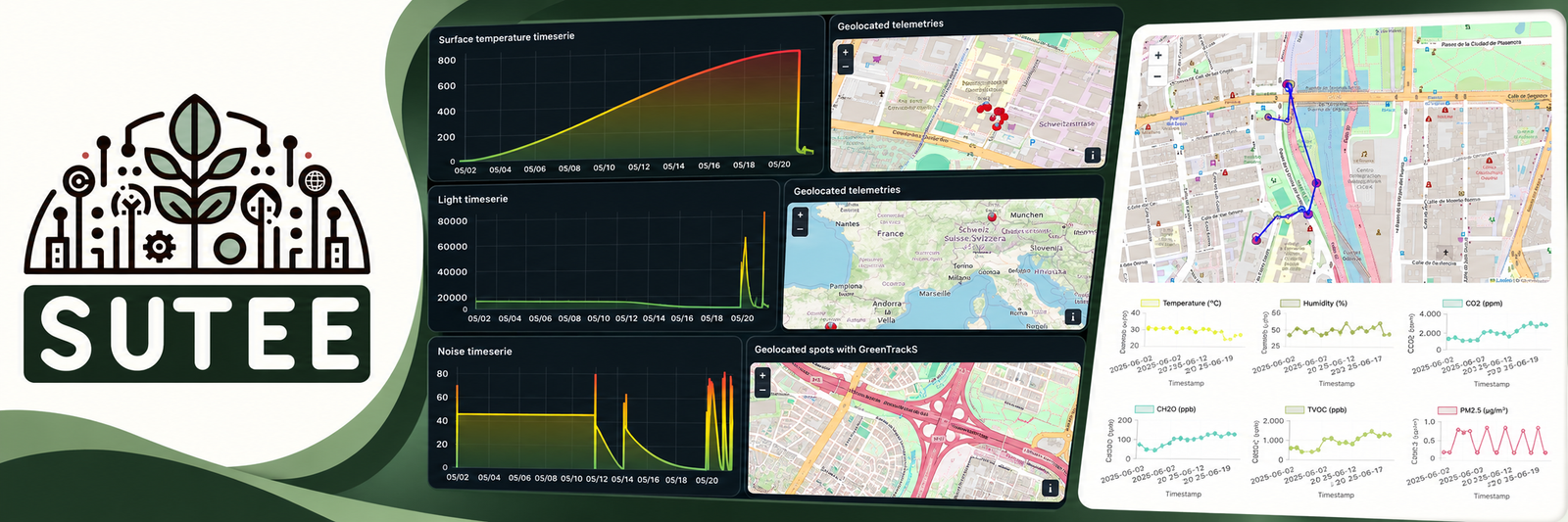
The third module is the online dashboard. Once the user has collected several samples during an excursion, the data are sent to an online platform that shows the results on a map and through different types of graphs, representing the data both spatially and temporally. This allows the fieldwork activity to continue later in the classroom, where students can analyse the route, compare measurement points and discuss how urban vegetation, traffic, shade or surface materials may influence environmental conditions.
From an educational perspective, the SUTEE IoT prototype supports inquiry-based and data-driven learning. Students can take measurements in contrasting urban locations, such as a park, a road, a pedestrian area, a school courtyard or a street with limited vegetation. By comparing the values obtained in each place, learners can reflect on the impact of trees and green infrastructure on air quality, thermal comfort and environmental wellbeing. The sensor can be borrowed from UNED, UPM, PHW, GUF and DOUKAS.